Botox or Fillers? How to Choose the Right Treatment in Calicut
A skin guide from Ceori Skin Clinic, Calicut.
The pimples left ages ago. The marks stayed.
Maybe you’ve got a few small dents on your cheeks that only show up under bright bathroom light. Maybe it’s a rough patch where makeup always seems to settle. You’ve tried creams, home remedies, whatever your cousin swears by. Nothing has shifted them.
So you’ve probably typed acne scar treatment in Calicut into Google by now. Here’s the catch: “acne scars” isn’t one thing. A dent, a raised bump and a leftover dark mark are three different problems, and they don’t respond to the same treatment. Asking “what’s the best treatment?” gets you nowhere. “What kind of scar do I have?” is the better question.
That’s what this guide is for. We’ll go through the main scar types, what dermatologists generally use for each, and what to expect from the treatments at our skin clinic in Calicut.
Short on time? Here’s the gist. The type of scar decides the treatment. Sunken scars, the most common kind, are usually treated with microneedling, peels, lasers or fillers, often a mix, while raised scars and keloids need something else. Almost everything takes a series of sessions, active acne should be sorted out first, and not every scar can be removed completely. Smoother and less noticeable is the honest goal.
A scar is just skin repairing itself after damage. Deep, inflamed pimples injure the layers under the surface, and the repair job doesn’t always put things back as they were. Too little tissue and you get a dent. Too much and you get a raised mark.
You didn’t cause this by being careless, and it isn’t a hygiene problem. Picking and squeezing does make scarring more likely, though, so try to leave pimples alone. Easier said than done, we know.
The American Academy of Dermatology sorts acne scars into a few broad groups, and each one is treated differently.
Depressed (sunken) scars are the dents. When most people say “acne scars,” this is what they mean. There are three common shapes: ice pick scars look small on the surface but go deep into the skin; boxcar scars are round or oval dents, wider than ice pick scars; rolling scars are wide and shallow, and a cluster of them can make the skin look wavy.
Raised scars sit above the skin and feel firmer than what’s around them. Doctors call them hypertrophic scars.
Keloids are raised scars that grow past the original spot. They can be hard to treat and sometimes come back, which is why they get handled on their own.
Dark marks aren’t really scars at all. After a pimple heals, it can leave a flat dark or red patch behind, and these usually fade over time. If the mark is flat and your skin feels smooth to the touch, this is probably what you have. A dermatologist can usually tell in a minute.
The Mayo Clinic is blunt about it: no single acne scar treatment is best for everyone. What works depends on your scar type, your skin type and how severe the scarring is.
With that in mind, here’s how the usual options line up.
Microneedling uses tiny needles to make controlled micro-injuries, which nudge the skin into repairing itself and building collagen. It’s commonly used for sunken scars and uneven texture, and it’s often paired with peels or radiofrequency. Mayo calls it simple, with a low risk of colour change, though the results are subtle and you may need to repeat it.
Chemical peels strip away the top layer of skin and prompt new collagen. They’re used for depressed scars and uneven tone. The AAD says mild peels typically take 3 to 5 sessions, spaced 2 to 4 weeks apart.
Lasers can resurface skin or smooth the area around a scar, and they’re used for sunken, papular and raised scars. One caution from Mayo: the risk of side effects is higher on darker skin. That matters here in India.
Fillers work for indented scars by adding volume underneath. They’re temporary, so you’d need top-ups.
For raised scars and keloids, corticosteroid injections are a common choice. And for individual scars, surgery is an option: punch excision takes out a single scar, while subcision releases a scar that’s tethered to the tissue below. These suit specific scars rather than overall texture.
Scars rarely come in just one type, so dermatologists often combine two or three of these. Microneedling plus peels is a common pairing.
People skip this step, and it matters. Get acne under control before starting scar treatment. Otherwise, new breakouts can undo the work. If you’re still getting active pimples, your dermatologist will usually deal with those first, then move on to the marks.
Mention any acne medicines you’ve used in the past couple of years, too. Some treatments don’t combine well with certain acne drugs.
We’re at Eranhipalam Junction, Calicut, and our care is built around customised skincare plans, with a focus on safety, quality and comfort. Between clinical dermatology, cosmetic dermatology and cosmetic surgery, a scar can be looked at from more than one angle. Here’s what our own pages say about the treatments that matter most for acne scars.
Our acne scar microneedling treatment uses controlled micro-injuries to stimulate collagen production, with the aim of improving texture and making scars less visible over time. We usually recommend a series of sessions a few weeks apart. How many depends on your scars and how severe they are. Afterwards, you may notice some redness and mild swelling, which usually settles in a day or two. Our page says it’s generally suitable for all skin types, but we’d still want you to have a consultation first.
Our chemical peel treatment is used for uneven pigmentation, fine lines and mild scarring. It can also help with mild to moderate acne and enlarged pores, though severe cases may need something else. A series of around 3 to 6 sessions may be recommended, depending on the person, and a session generally takes between 30 minutes and an hour. Downtime depends on the peel. Some leave only slight redness; deeper ones can need a few days.
Some scars need more than a surface treatment. For those, we offer scar revision surgery. The technique depends on the type and severity of the scar, and can include excision, dermabrasion or laser therapy, usually under local anaesthesia. Expect some swelling and redness at first, with full recovery taking anywhere from a few weeks to a few months. And we’ll be honest about the limits: complete removal is often not possible. The aim is a scar that’s less noticeable.
Thick, raised scars that keep spreading? Ask about our keloid treatment, which can include corticosteroid injections, laser therapy and cryotherapy.
The full list of what we offer is on our cosmetic dermatology and clinical dermatology pages.
Our team includes consultant dermatologists Dr Daisy Thomas, Dr Nimitha, Dr Simin, and Dr Jijo Joseph, our consultant plastic surgeon. With dermatology and plastic surgery under one roof, a scar that needs a skin-surface treatment and one that needs surgery can both be assessed in the same place.
Recovery depends on what you’ve had done, but some things hold for nearly all of it.
Redness and swelling are normal for a day or two after microneedling, and they last longer after deeper peels or surgery. If your skin flakes after a peel, leave it alone. Picking is how new marks happen.
Sun is the big one. Treated skin is more sensitive and marks darker more easily, so wear sunscreen every day and stay out of direct sun where you can. Follow whatever aftercare your doctor gives you, and ask before you go back to your usual products or makeup.
And be patient. Collagen takes weeks to build, so what you see two weeks after a session isn’t the final result. Most people judge progress over a few months.
Mostly small things. Redness, swelling, dryness, all of which pass. Skin colour can change in some cases, particularly after deeper peels and lasers, and Mayo points out that darker skin is more at risk of this. Surgery brings the usual risks that come with any procedure, including infection and scarring. Our scar revision page lists them.
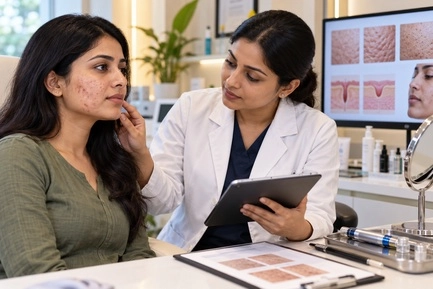
Which is why we don’t start with treatment. We start by looking at your skin and asking questions: your skin type, your history, what you’ve tried before. Answer those honestly, and your doctor can steer you away from the options that don’t suit you.
You don’t need to know the jargon to have a useful consultation. You just need to ask a few plain questions. What kind of scars do I have? What would you do about them, and would you combine treatments? How many sessions, and how far apart? How much better will my skin realistically look? What will the first week look like, and when can I get back to normal? Is my acne settled enough to start, and is anything risky for my skin tone?
Jot them down. Nobody remembers half of what they meant to ask once they’re sitting in the chair.
It’s straightforward.
Not always, and any clinic promising otherwise is overselling. Many scars can be made much smoother and far less noticeable. Total removal often isn’t possible, and your doctor will tell you what to expect for your type.
There isn’t a single best one. Sunken scars are often treated with microneedling, peels, lasers or fillers, sometimes combined, while raised scars and keloids go down a different route. Seeing a doctor is the only way to know which is yours.
Depends on how severe your scars are. We usually suggest a series, a few weeks apart, rather than a single visit.
Very little. You may be red and a bit swollen, and that usually settles within a day or two.
It’s better to get the acne under control first; otherwise, new breakouts can undo your results. Your dermatologist will tell you when the timing is right.
They can help with mild scarring and uneven tone. How much depends on how deep your scars go.
Many are used on darker skin. Some, like deeper peels and certain lasers, carry a higher risk of colour change, so get assessed before you decide.
Treatments that rebuild collagen can give lasting improvement. But skin keeps ageing, and new acne can leave new scars, so daily sunscreen and well-controlled acne are what protect your results.
If those marks have been getting to you, a consultation is the easiest first step. Call +91 8891 229 555 or 0495 2387000, or use our contact page to book at our skin clinic in Calicut, at Eranhipalam Junction, Calicut.