Breast Rash or Something More? What Your Skin Might Be Telling You This Pink October
The short answer: most breast rashes come down to heat, sweat, friction, a fungal infection or a product your skin didn’t agree with, and they clear up once treated. But a scaly patch on one nipple, or a breast that turns red, warm and swollen and doesn’t improve on antibiotics, is worth showing a doctor. Both can be signs of rare breast cancers that often don’t cause a lump.
Ask anyone how to check for breast cancer, and you’ll get the same answer. Feel for a lump.
It’s good advice. It’s just not the whole story.
Your breasts are covered in skin, and skin gets rashes. A hot, sticky day brings on prickly heat. The fold underneath gets sore. You switch detergents,s and suddenly everything itches. It’s irritating, but it’s almost always harmless.
Once in a while, though, something that looks completely ordinary turns out not to be. There’s no lump. It barely hurts. It looks like eczema, or maybe an infection, so you leave it for another week. And then another.
That’s what we want to talk about.
First, the reassuring bit
Most breast rashes have dull, harmless explanations, and hot, humid weather makes them more likely.
The most common one is intertrigo. It’s a red, sore, sometimes damp rash in the fold under the breast, caused by skin rubbing against skin while heat and sweat get trapped in between. Sometimes a fungal or bacterial infection joins in. Prickly heat is those tiny red bumps you get after sweating. Contact dermatitis is your skin reacting to a soap, perfume, detergent or bra fabric. Eczema shows up as dry, itchy patches, often on both sides. And if you’re breastfeeding, mastitis can leave one breast red and painful.
The good news? All of these get better with the right treatment.
If there’s one thing to take away from this article, it’s this. A rash that gets better with treatment was almost certainly just a rash. A rash that doesn’t is the one to get checked.
A quick way to tell
Probably nothing to worry about:
Both breasts are affected
It gets better with treatment
You can link it to heat, sweat or a new product
It’s itchy, but the skin itself feels normal
Your nipple looks the way it always has
Mastitis that settles on antibiotics
Worth getting checked:
Only one breast or one nipple is affected
It doesn’t get better with treatment
There’s no obvious reason for it
The skin looks thickened, dimpled or pitted
Your nipple has newly turned in, or it’s scaly, crusted or bleeding
Redness and swelling that antibiotics don’t touch
Ticking something on the second list doesn’t mean you have cancer. It just means it’s time to book an appointment instead of waiting to see what happens.
The nipple “eczema” that isn’t eczema.
Chances are you’ve never heard of Paget’s disease of the nipple. It’s rare, making up roughly 1 to 3 per cent of breast cancers, and it usually means there’s a breast cancer in the tissue behind the nipple.
The tricky part is how harmless it looks. It starts as a red, scaly rash, always on the nipple first, and it can spread to the darker skin around it. It might itch, burn or feel sore. Left alone, it can crust over, bleed or break down. No wonder it gets mistaken for eczema.
There are a few giveaways, though. It usually affects just one side. It starts on the nipple itself, while eczema tends to start on the skin around it. And eczema treatment doesn’t make it go away.
To be fair, nipple eczema is real, and it’s far more common. It usually clears up nicely with treatment. But you can’t always tell the two apart just by looking, which is why the NHS advises seeing a doctor about any change to the skin of your nipple or the area around it.
So if one nipple has a scaly or crusted patch, please don’t just keep trying stronger creams. See a doctor. A small skin biopsy can give you a clear answer. And if it does turn out to be Paget’s disease, catching and treating it early gives a good chance of a full recovery.
The “infection” that antibiotics don’t fix
Inflammatory breast cancer is another rare one. It tends to grow faster than the more common types, and it often doesn’t form a lump. That’s exactly why it can pass for an infection.
Instead of a lump, you might see redness spreading over a third of the breast or more. The breast may look swollen, or feel warmer and heavier than the other one. It can be tender, painful or itchy. Sometimes the skin thickens and develops tiny pits, a bit like orange peel. Doctors call this peau d’orange. The nipple may pull inward, and you might feel swollen glands under your arm or near your collarbone. These changes usually build up over a few weeks to a few months.
Now, a red, sore breast is much more likely to be an infection or inflammation such as mastitis, especially if you’re pregnant or breastfeeding. So your doctor will probably try antibiotics first, and that’s a perfectly sensible place to start.
But if things haven’t improved after about a week, or they’re getting worse or spreading, go back. Tell your doctor plainly that it hasn’t helped. You may need a few more tests. You’re not being a nuisance. You’re being careful, and that’s exactly what you should be doing.
Other changes worth mentioning
Not every warning sign is a rash. Let your doctor know if you notice any of these:
Swelling in all or part of a breast, even if there’s no lump
Skin that looks dimpled or puckered (raising your arms in front of a mirror can make this easier to spot)
A nipple that has recently started turning inward (if yours always has, that’s just your normal)
Nipple or breast skin that’s red, dry, flaky or thickened
Discharge from the nipple that isn’t breast milk, especially if there’s blood in it
Swollen glands under your arm or near your collarbone
New pain in the breast or nipple
Most of the time, these turn out to be nothing serious. They’re just not the kind of thing to brush aside.
And men, this applies to you too. Breast cancer in men is rare, but it does happen. Men also tend to be diagnosed later than women, partly because they’re less likely to mention a change to their doctor.
Your monthly mirror check
Think of this less as an exam and more as getting to know yourself. You’re not hunting for disease. You’re just learning what normal looks like for you, so you’ll spot it if something changes.
If you have periods, try doing it a few days after your period ends, when your breasts are less likely to be tender or swollen. If you don’t, just pick a date and stick to it each month.
Stand in front of a mirror with your arms relaxed by your sides. Look at the size, shape, colour and skin of each breast. They won’t match perfectly, and that’s completely normal. Then raise both arms over your head and look again, checking for any dimpling, puckering or change in outline. Next, press your hands firmly on your hips so your chest muscles tighten, and take one more look. Finally, check your nipples for any scaling, crusting, discharge or new inward turning.
After that, gently feel each breast and armpit with the pads of your middle fingers. Lying down works, and so does the shower.
That’s it. A few minutes, once a month.
What really happens at the appointment
Plenty of women put off seeing a doctor because they’re nervous about what comes next. In reality, it’s usually simpler than you’d expect.
Your doctor will ask what’s changed, when you first noticed it and what you’ve already tried. Telling them something like “I’ve been using eczema cream for three weeks, and it looks the same” genuinely helps. Then they’ll examine both breasts and your armpits.
If they want a closer look, they might send you for an ultrasound, a mammogram or both. If you’re under 40, an ultrasound is more likely, because younger breast tissue tends to be denser. If the concern is a skin or nipple change, they may take a small sample of skin for testing.
Most of the time, the news is good. And when it isn’t, finding breast cancer early gives treatment the best chance of working.
Questions people often ask.
Can a breast rash be a sign of cancer? It can, but that’s rare. Most breast rashes turn out to be intertrigo, a fungal infection, eczema, heat rash or simple irritation. A scaly or crusted rash on one nipple, or a red, swollen breast that doesn’t improve on antibiotics, could point to Paget’s disease or inflammatory breast cancer and should be checked.
When should I see a doctor about a breast rash? If it isn’t getting better with treatment, see a doctor. If the skin of your nipple has changed, or your breast is red, swollen and warm, don’t wait. Book an appointment soon.Does breast cancer always cause a lump? No. Inflammatory breast cancer often doesn’t, and Paget’s disease can show up as a nipple rash, with or without a lump.
Is an itchy nipple a sign of cancer? Usually not. Dry skin, eczema, friction from clothing and breastfeeding are far more likely causes. It’s worth getting checked if the nipple looks red, scaly or crusted, especially on just one side.
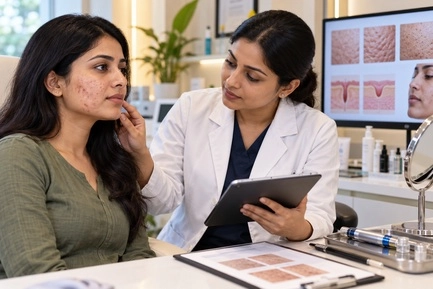
Can a dermatologist check a breast skin change? Yes. A dermatologist can examine the skin and help work out whether it’s a common rash or something that needs further tests. If anything looks unusual, they’ll tell you what to do next, such as seeing a breast specialist.
If you remember just one thing
Most breast rashes really are just rashes. They turn up, you treat them, and they’re gone.
But if something shows up on only one side, won’t clear with treatment, or simply doesn’t feel right to you, trust that feeling. It takes one appointment to find out. Waiting could cost you a lot more.
Get to know your normal, and speak up when something changes. That’s really all Pink October asks of you.
And if this helped, pass it on to your mother, your sister, your friends. You never know who might need to read it.
Noticed something? Come and talk to us.
If you’ve been looking for the best skin clinic in Calicut to check a rash or skin change that just won’t settle, we’d be glad to help. At CEORI Skin Clinic, our dermatologists can take a proper look at any change on your breast and tell you whether it needs further attention. If it does, we’ll guide you on where to go next. Every consultation is private, unhurried and handled with care.
📞 Call +91 88912 29555 or 0495 238 7000, orcontact us to book your consultation.